I don’t have any exciting trips to write about this week, so I guess I’ll have to write about science. The blog is called For Science after all!
I’ve randomly decided to write about lithium/silver vanadium oxide batteries and their use in implantable defibrillators. In grad school I saw a talk on the subject by Esther Sans Takeuchi and it was so interesting that it’s one of the few talks that has stuck with me after all this time. Plus, I just learned that she has more US patents than any other woman in the country!
Lithium/silver vanadium oxide batteries are designed to power an implantable cardioverter-defibrillator or ICD. Have you ever heard about a relatively young, healthy person who died from sudden cardiac arrest? An ICD is an implanted device, similar to a pacemaker, that will give that person the life-saving shock to their heart that they need to survive. The device monitors the electrical signals of the heart and if it senses an arrhythmia, it will deliver a high-voltage shock to get the heart started again. ICDs are the internal version the external defibrillators that you often see doctors using on hospital TV shows to bring patients back to life.
An ICD is meant to live in a patient’s chest for their whole life, so it needs a long-lasting, reliable power source that can deliver a high voltage shock. Lithium/silver vanadium oxide (or Li/SVO) batteries were developed for this purpose in the late 80s by scientists (including Esther Takeuchi) at Greatbatch. The battery is made up of a lithium metal anode and a cathode material with the structure Ag2V4O11.

Ag2V4O11 structure (source)
Now, lithium ion batteries are a subject that deserve their own blog post, but the quick version is that ions of lithium come from the lithium metal anode and displace the silver ions that are located between the layers of vanadium oxide. This reaction causes electrons to flow from the anode, through the device, to the cathode, which gives you electricity.
What’s special about the Li/SVO reaction is how many lithium ions can fit into those layers. The reaction for the cell is Ag2V4O11 + 7 Li –> Li7Ag2V4O11, meaning that 7 lithium ions can drift over from the lithium metal anode and cram themselves into the layers of the cathode material. Because this number is so high, the battery is able to output its electric charge over a long period of time. Another reason Li/SVO is perfect for this application is its high open circuit voltage. The combination of the lithium and SVO materials have a high electrical potential — the electrons in the anode really want to flow to the cathode. This high voltage is extremely important because it is needed to give the high-voltage shocks that will restart a heart.
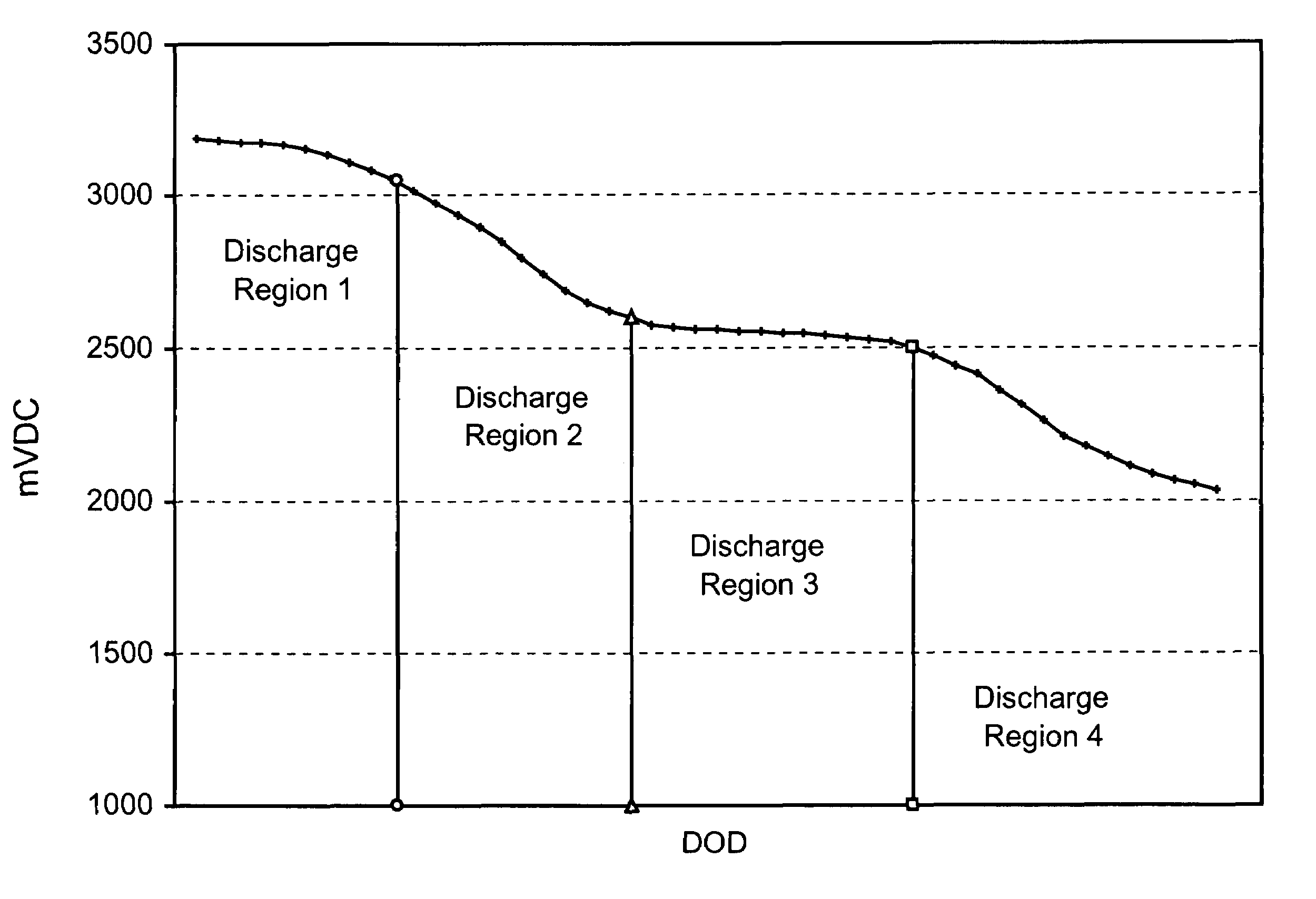
One last cool feature of the Li/SVO battery is that it has a built-in way to tell when the battery is close to running out of juice. Every positive lithium ion that is introduced into the cathode material, has to be balanced by a change in the electrical state of the material — it has to become more negative to maintain the neutral balance. With every change in the electrical state of the material, the voltage takes a slight hit. Look at it visually in this graph:
(source)
You can see that with every change in charge state, we see a little plateau in the voltage curve. The nice side benefit of this reaction is that just by measuring the voltage, we can clearly see when this chemical reaction is close to finishing and thus when the battery is close to dying. This way you can wait until the battery is truly on its last legs before performing an invasive procedure on the patient to change it.
Anyway, that’s a brief summary of how Li/SVO batteries just happen to be the perfect technology for powering implantable cardioverter-defibrillators. Hope it was interesting! If you want to learn more, I recommend this paper. And to learn more about Prof. Takeuchi’s current work, visit her website.
 For Science!